
Roofing Terms Explained: A Bellevue Homeowner's Glossary
Roofers use words like flashing, valley, ridge cap, underlayment and pipe boot — and it helps to know what they mean before you agree to a repair. This glossary explains the roofing terms Bellevue homeowners hear most, in plain language, with what each part does on your roof.
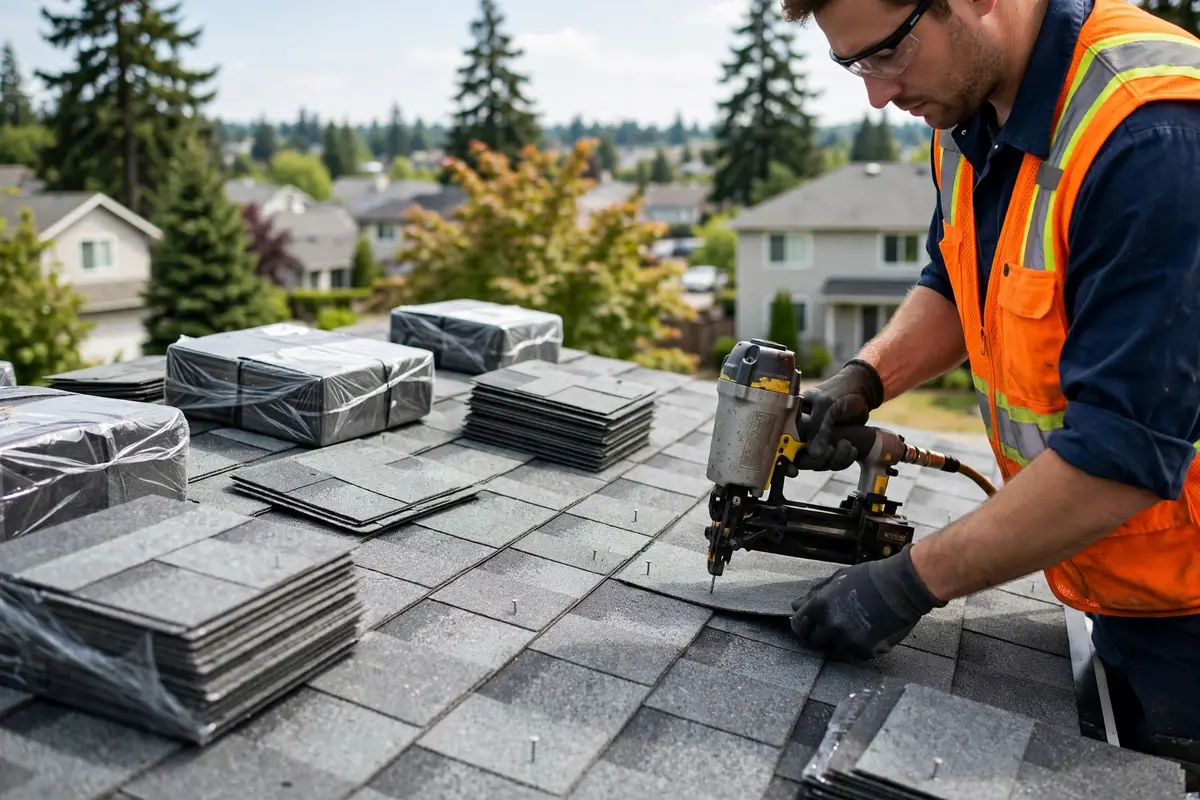
Roofing has its own language. When a roofer says the valley flashing has failed or the pipe boot is cracked, you should not need a dictionary to know whether the repair matters and what it costs. These are the terms Bellevue homeowners hear most, explained the way we would explain them on your roof.
Shingles and Their Parts
Start with the shingle itself: what it is made of, the two types you will see in Bellevue, and the parts that fail first. Our guide to 3-tab vs architectural shingles explains how to tell which type is on your roof.
Asphalt shingle
The shingle on most Bellevue roofs: a fibreglass mat coated with asphalt and covered in mineral granules. The granules protect the asphalt from sunlight, the asphalt keeps the water out, and the mat gives the shingle its strength. Asphalt shingles are also called composition shingles.
Three-tab shingle
A single-layer shingle cut into three tabs, giving a flat, uniform pattern on the roof. Three-tab shingles are lighter and thinner than architectural shingles, and they are the type most often found on older Bellevue homes — including many lines that are now discontinued.
Architectural shingle
A laminated shingle made of two or more layers bonded together, giving a thicker, dimensional look. Architectural shingles are heavier than three-tab, they generally last longer, and they are the type we repair most in Bellevue — including GAF Timberline, CertainTeed Landmark, Owens Corning Duration and Malarkey Vista.
Tab
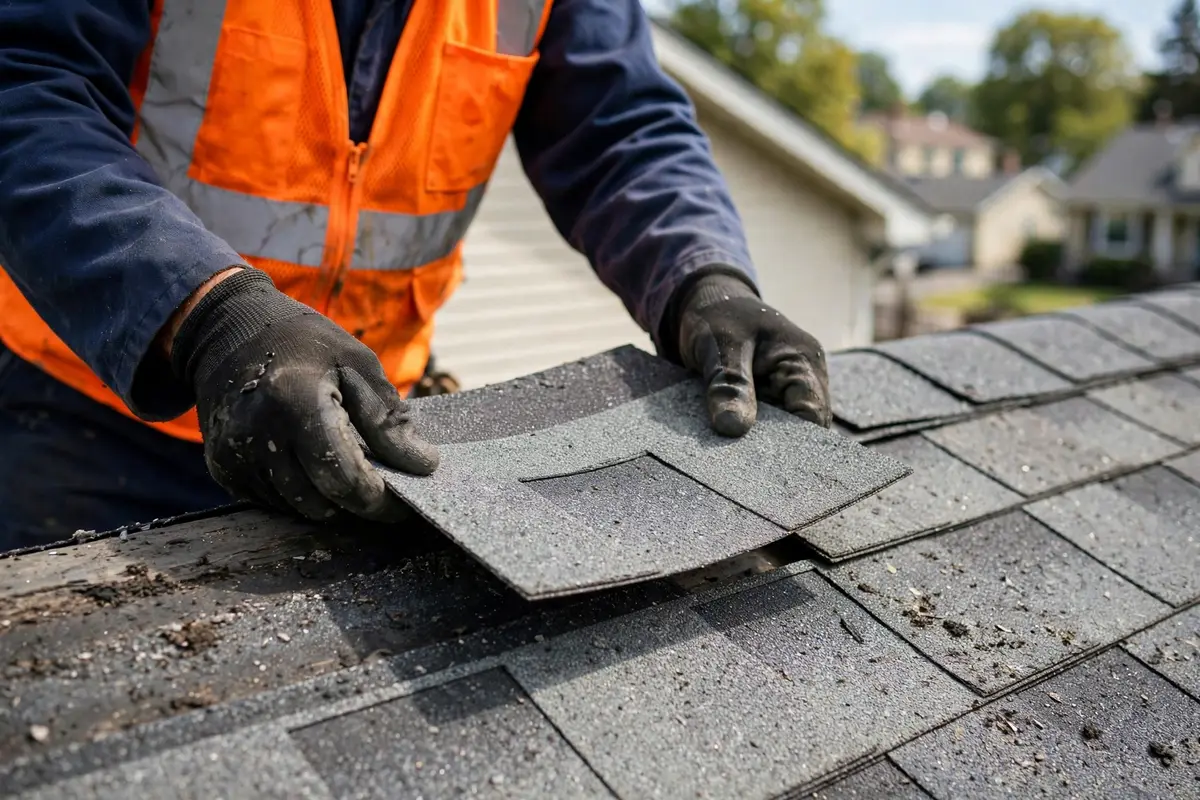
One of the exposed sections of a shingle — the part you see from the ground. On a three-tab shingle, each shingle has three tabs; on an architectural shingle, the tabs are cut into a layered pattern. Wind damage usually starts at a tab: the wind lifts its edge, breaks the seal and, if it flexes often enough, creases it.
Sealant strip
A band of adhesive on the back of each shingle that bonds it to the shingle below once the sun warms the roof. The seal is what keeps tabs lying flat in the wind. When the seal fails with age or heat, tabs lift, flap and let rain in — and a lifted tab that will not reseal needs replacing.
Granules
The fine mineral grains pressed into the surface of an asphalt shingle. They protect the asphalt from ultraviolet light, give the shingle its colour, and add fire resistance. When granules wash into the gutters, the asphalt underneath is exposed to the sun and ages faster — which is why granule loss is one of the first signs a roof is wearing out.
Where Roof Slopes Meet
A roof is a set of slopes joined together, and the joins have their own names — and their own problems.
Valley
The inside angle where two roof slopes meet and water collects on its way to the gutters. Valleys carry more water than any other part of the roof, so they are lined with metal flashing and underlayment beneath the shingles. A valley full of leaves holds water against the shingles instead of draining it.
Ridge
The peak of the roof, where two slopes meet at the top. The ridge is covered by ridge cap shingles, and on most modern roofs it also carries the ridge vent that lets damp air out of the attic. The ridge takes the highest wind exposure on the roof, which is why ridge caps are often the first shingles to lift.
Hip
The outside angle where two roof slopes meet on a hip roof — the sloping edge that runs from the eaves up to the ridge. Hips are covered by hip cap shingles, the same kind of cap used on the ridge. Like the ridge, a hip catches the wind first and its caps are a common place for wind damage to start.
Ridge cap
The shingles that cover the ridge, bent over the peak to seal it. Ridge caps are thicker than field shingles and take the most wind on the roof. When a ridge cap lifts or goes missing, rain can get straight into the peak — which is why a missing ridge cap is a repair, not a wait-and-see.
Rake
The sloping edge of a roof at the gable end — the edge you see from the side of the house. The rake is finished with a drip edge or a rake trim, and wind can lift shingles along it. Damage at the rake often shows as lifted tabs in a line up the slope.
Eave
The lower edge of the roof that overhangs the wall. The eaves carry the gutters, and the soffit underneath them holds the intake vents for the attic. Ice dams form at the eaves in a freeze, because the eaves stay cold while the roof above them is warmed by the attic.
Flashing and Waterproofing
Flashing and underlayment are the parts you rarely see, and the parts that cause most leaks. Our roof flashing and ridge cap repair page covers the joints we fix most.
Flashing
Thin metal — usually aluminium or galvanised steel — fitted wherever the roof meets something else: a chimney, a wall, a skylight or a valley. Flashing seals the joint so water runs over it instead of into it. Most roof leaks start at flashing, not in the middle of the shingles, because the joints move with heat and the sealant ages.
Step flashing
Small L-shaped pieces of flashing fitted in a staircase pattern where a roof meets a vertical wall, such as a chimney or a dormer. Each piece overlaps the shingle below it and sits under the shingle above it, so water is stepped down the slope instead of running behind the wall. Step flashing fails when it rusts, bends or pulls away from the wall.
Counter flashing
The second layer of flashing that covers the top edge of step flashing, usually set into the chimney mortar or fixed to the wall. It stops water running down the wall and behind the step flashing. When counter flashing cracks or comes loose, water gets behind the flashing and into the house — often showing up as a stain on the ceiling beside the chimney.
Pipe boot
The rubber or metal collar that seals around a plumbing vent pipe where it passes through the roof. The boot is the most common single leak on a shingle roof: the rubber cracks with age and sun, and water runs down the pipe into the attic. A cracked boot is a small repair — the boot is replaced and the shingles around it resealed. Our roof vent repair service covers pipe boot replacement.
Drip edge
A metal strip along the eaves and rakes that guides water off the roof and into the gutters instead of letting it run back under the shingles or down the fascia. Without a drip edge, water wicks under the first course of shingles and rots the edge of the decking. It is a small part, but a roof without one ages faster at the edges.
Underlayment
The layer between the roof deck and the shingles — felt or synthetic — that acts as a second barrier if water gets past the shingles. Underlayment is not a roof on its own: left exposed, it breaks down in the sun and lets water through. Underlayment comes in felt and synthetic types.
Ice-and-water shield
A self-adhesive waterproof membrane laid under the shingles at the eaves, valleys and around penetrations. Unlike ordinary underlayment, it seals around nail holes, so it keeps working where water backs up — under an ice dam, for example, or in a valley in heavy rain. It is the backup layer in the places where water is most likely to sit.
Ventilation and the Attic
The attic is part of the roof system, not just the space under it — and its vents have names worth knowing.
Ridge vent
A continuous vent along the peak of the roof that lets warm, damp air out of the attic. It is the exhaust half of the ventilation system, and it only works if the soffit vents below it are open — without intake, a ridge vent vents almost nothing.
Soffit vent
A vent in the soffit — the underside of the eaves — that lets fresh air into the attic. Soffit vents are the intake half of the ventilation system. They clog with paint, dust and insulation, and on some older Bellevue homes they were never fitted at all.
Box vent
A single vent fitted near the ridge that lets air out of one part of the attic. Older roofs often have several box vents instead of a continuous ridge vent. They work, but they only ventilate the slope near them, so a roof with box vents on one slope and none on the other is only half ventilated.
Turbine vent
A spinning metal vent that turns in the wind and pulls air out of the attic. Turbines move a lot of air on a windy day and almost none on a still one. They are checked on every inspection we do — and we tell you honestly whether the fix is one we do or one for a specialist.
Attic
The space between the top-floor ceiling and the roof deck. The attic is where ventilation problems show first: damp timbers, mould, rusted nails and frost on the deck in cold weather. A roof inspection always includes the attic, because the damage up there tells you what is happening to the shingles above it.
Roof deck
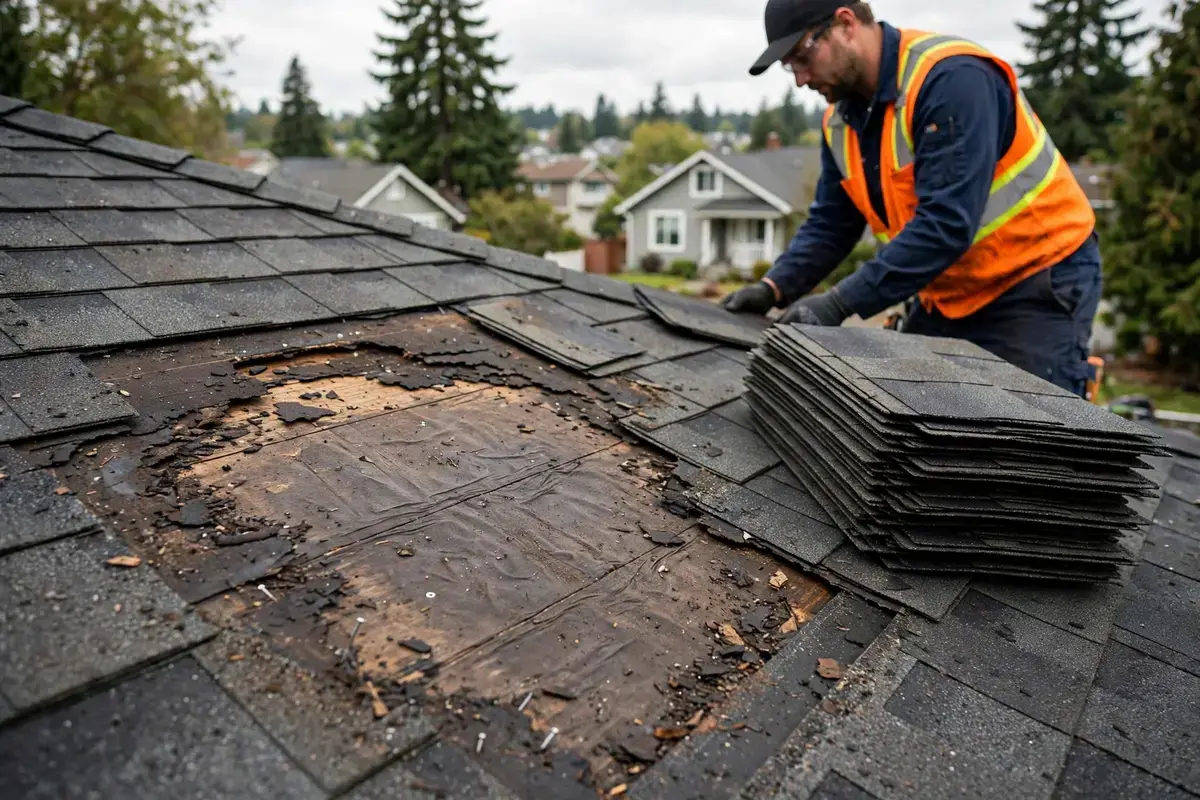
The boards or plywood the shingles are nailed to — the structure under the underlayment. If the deck is soft, rotted or holed, shingles cannot be nailed into it properly, and the deck has to be cut out and replaced before any shingle work. A hole in the deck is one of the things that turns a repair into a replacement.
Fascia
The board along the edge of the roof, behind the gutters, that the gutter is fixed to. The fascia takes the weather at the eaves and can rot if water gets behind the gutter or the drip edge is missing. Rotten fascia is usually found during a repair, not from the ground.
Soffit
The underside of the eaves, between the wall and the fascia. The soffit holds the intake vents for the attic, and it is where you will see staining if water is getting in at the eaves. A sagging or stained soffit is worth an inspection, because it usually means water has been getting in for a while.
Damage Words, Translated
When shingles fail, they fail in shapes, and each shape has a name. Our guide to fishmouthing, creasing and delamination covers the strangest of them in detail.
Curling
When the edges of a shingle turn up, usually from age and drying out. Curled shingles no longer lie flat, so wind can get under them and rain can be driven in behind them. A few curled shingles can be replaced; curling across a whole slope usually means the roof is ageing out.
Cupping
When the centre of a shingle sinks and the edges curl up, making a cup shape. Cupping is a sign of moisture imbalance — often poor ventilation underneath — and it leaves the shingle open to wind and rain. Like curling, a few cupped shingles are a repair, but cupping across the roof points to a wider problem.
Fishmouthing
When the corners of a shingle tab lift while the centre stays stuck, leaving an open shape like a fish's mouth. The adhesive seal has failed in the middle of the tab.
Creasing
A horizontal fold across a shingle tab, caused by the wind flexing it up and down until it weakens and folds. A creased shingle will not flatten out or reseal, and it usually tears off in the next strong wind — so creased shingles always need replacing.
Delamination
When the layers of a laminated, architectural shingle come apart. Long exposure to heat and moisture breaks the bond between the layers, so the top layer lifts, bubbles or peels away. Delamination is an ageing problem, and when it is widespread the roof is near the end of its life.
Granule loss
The wearing away of the mineral grains on a shingle's surface. Some loss is normal with age, and you will see a few granules in the gutters after a storm. Heavy loss — bald patches where the asphalt shows through — means the shingle has lost its protection from the sun and is ageing fast.
Blistering
Small bubbles or raised spots on a shingle's surface, caused by trapped moisture or heat expanding under the granules. Blisters usually break open and leave a bare patch. A few blisters are cosmetic; blistering across a slope, with granule loss, is a sign the shingles are wearing out.
Nail pop
A nail that has worked its way up through the shingle above it, leaving a raised bump — or a hole if the nail has come right through. Nail pops happen when the deck moves or the nail was not driven properly, and they let water straight into the roof. A popped nail is a small repair, but the shingles around it need checking too.
Measurements and the Job
The last group is the language of the quote: how roofers measure a roof and describe the job.
Square
A roofer's unit of area: one square is 100 square feet of roof. A typical Bellevue home might be 15 to 25 squares, depending on the size and pitch of the roof. Quotes are often given per square, which is why two roofs of the same footprint can cost very different amounts — pitch and complexity change the count.
Bundle
A pack of shingles — usually enough to cover about a third of a square. Bundles are how shingles are sold and carried up the roof, and how a repair is priced in materials. Three bundles make a square on most architectural shingles.
Pitch
How steep a roof is, measured as the rise over a 12-inch run — a 6/12 pitch rises 6 inches for every 12 inches across. Steeper roofs are harder and slower to work on, which is one reason they cost more to repair. Pitch also affects how water runs off: a low pitch holds water longer, and a steep pitch sheds it fast.
Tear-off
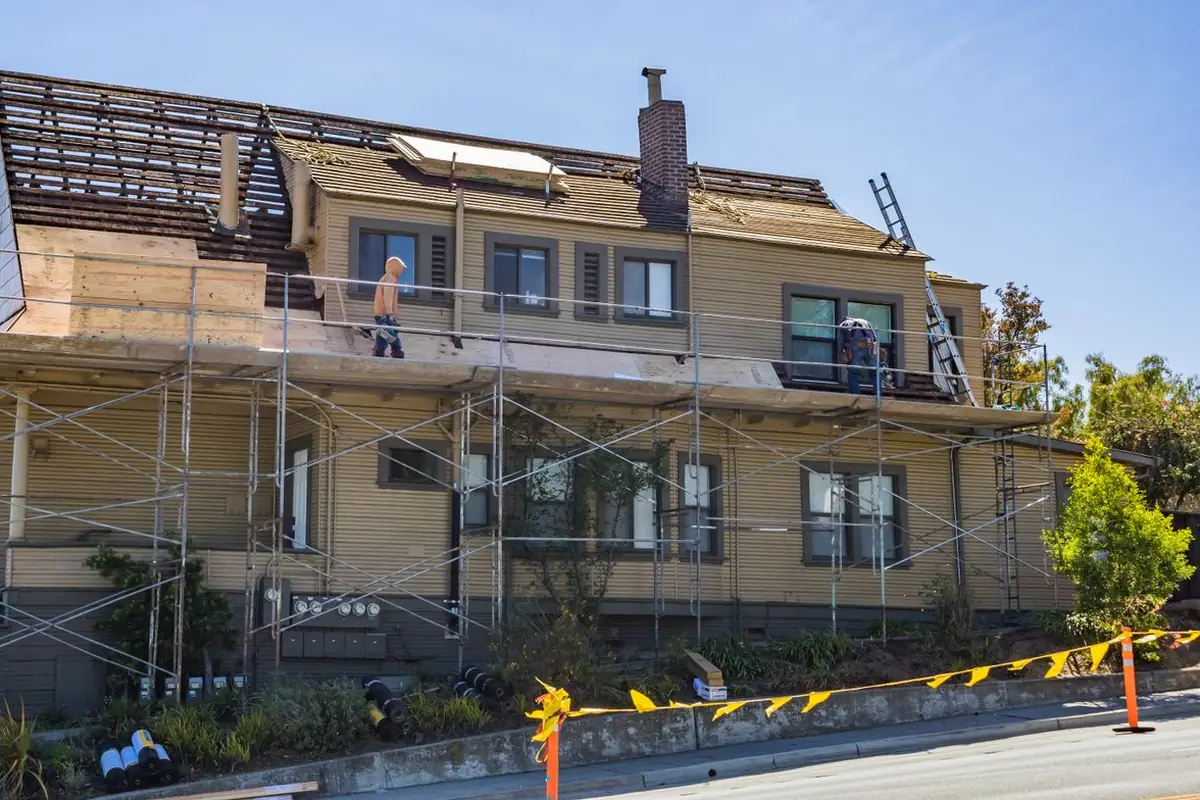
Removing the old shingles down to the deck before putting new ones on. A tear-off is needed for a replacement, and it is the only way to see the decking properly. A repair does not need a tear-off — only the damaged shingles are removed, and the sound ones stay.
Repair vs replacement
The decision every ageing roof faces: fix the damaged part, or replace the whole roof. The rule we use is cost-based — if the repair would cost more than about 30% of a new roof, or the damage covers a large part of the roof, replacement is usually better value.
Workmanship guarantee
The roofer's promise to come back and fix a repair that fails because of the work, not the weather. Our repairs carry a 5-year workmanship guarantee: if a repair fails because of our work, we come back and fix it. A guarantee is only as good as the company behind it, which is one more reason to check a roofer before you hire them.
Need professional help? If any of these terms describe your roof, our roof inspection will show you which ones apply to your home, with photos and a written estimate. And if you are choosing a roofer, read our guide to finding a shingle repair company in Bellevue, WA first. Call (425) 738-3670 or request an estimate.
Key takeaways
- A tab is the visible part of a shingle; the sealant strip is what holds it flat.
- Most leaks start at flashing, valleys and pipe boots — not in the middle of the shingles.
- Ventilation is a system: soffit vents in, ridge vent out — both halves have to be open.
- Damage has names: curling, cupping, fishmouthing, creasing, delamination and granule loss.
Heard one of these terms about your roof? Call (425) 738-3670.
Frequently Asked Questions
What is the difference between a three-tab and an architectural shingle?
A three-tab shingle is a single flat layer cut into three tabs, giving a uniform pattern. An architectural shingle is made of two or more layers bonded together, so it is thicker, heavier and looks dimensional. Architectural shingles generally last longer, and they are the type we repair most in Bellevue — including GAF Timberline, CertainTeed Landmark, Owens Corning Duration and Malarkey Vista.
What does flashing do on a roof?
Flashing is thin metal fitted wherever the roof meets something else — a chimney, a wall, a skylight or a valley — to seal the joint so water runs over it instead of into it. Most roof leaks start at flashing, not in the middle of the shingles, because the joints move with heat and the sealant ages. When flashing rusts, bends or pulls loose, water gets in behind it.
What is a pipe boot?
A pipe boot is the rubber or metal collar that seals around a plumbing vent pipe where it passes through the roof. It is the most common single leak on a shingle roof, because the rubber cracks with age and sun and lets water run down the pipe into the attic. A cracked boot is a small repair: the boot is replaced and the shingles around it resealed.
What is underlayment?
Underlayment is the layer between the roof deck and the shingles — felt or synthetic — that acts as a second barrier if water gets past the shingles. It is not a roof on its own: left exposed, it breaks down in the sun and lets water through. Underlayment is also the layer you see when shingles blow off, which is why a missing shingle needs covering quickly.
What is a ridge cap?
A ridge cap is the shingle bent over the peak of the roof to seal it. Ridge caps are thicker than field shingles and take the highest wind exposure on the roof, which is why they are often the first shingles to lift or go missing in a storm. A missing ridge cap lets rain straight into the peak, so it is a repair, not a wait-and-see.
What does granule loss mean?
Granule loss is the wearing away of the mineral grains on a shingle's surface. A few granules in the gutters after a storm is normal. Heavy loss — bald patches where the black asphalt shows through — means the shingle has lost its protection from sunlight and is ageing fast. Granule loss across a whole slope is one of the signs a roof is near the end of its life.
What is the difference between a valley and a ridge?
A valley is the inside angle where two slopes meet and water collects on its way to the gutters; a ridge is the peak where two slopes meet at the top. Valleys carry the most water on the roof, so they are lined with metal flashing. The ridge carries the ridge vent and takes the most wind. Both are joints, and both are common places for leaks to start.
What is roof pitch?
Roof pitch is how steep a roof is, measured as the rise over a 12-inch run. A 6/12 pitch rises 6 inches for every 12 inches across. Steeper roofs are harder and slower to work on, which is one reason they cost more to repair. Pitch also affects drainage: a low pitch holds water longer, and a steep pitch sheds it fast.
Call Now to Speak to a Specialist
Last updated: November 22, 2026. Author: Bellevue Shingle Masters.