
Roof Flashing & Ridge Cap Repair in Bellevue, WA
Roof flashing and ridge cap repair in Bellevue, WA — chimney, valley, skylight and ridge leaks fixed at the source. Serving Newport and Factoria (98006). Call (425) 738-3670.
More than half of roof leaks start at flashing, not in the shingle field. For roof flashing repair in Bellevue, WA, we find the failed joint and fix it at the source. Flashing is the metal that seals the transitions — where a roof meets a chimney, a valley, a skylight or a wall. When flashing fails, water gets in even though the shingles look fine. Ridge caps, the shingles that cover the roof’s peak, take the highest wind exposure and fail first. We repair both.
The Problem: Roof Flashing and Ridge Cap Repair
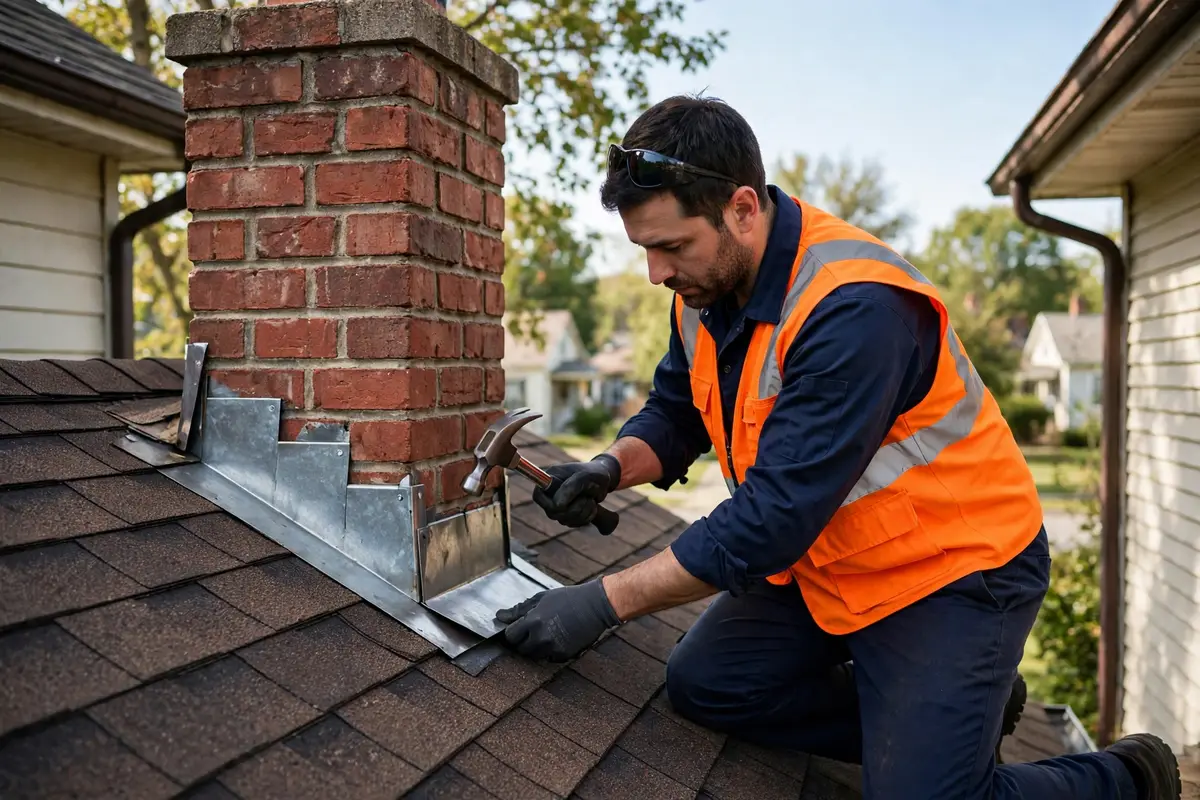
Flashing fails through sealant failure — the sealant ages, cracks and lets water past — or when metal corrodes or lifts, when a valley collects debris, or when a chimney’s step flashing was never properly installed. A water leak at roof valley joints usually starts where debris collects and holds moisture against the metal. Chimney flashing repair Bellevue homeowners ask for most often is for step flashing that has lifted or corroded where the roof meets the brick. Ridge caps fail through wind uplift at ridge and ageing. Both problems show up as leaks inside, often some distance from the actual failure.
Signs You Need Roof Flashing and Ridge Cap Repair
- A roof leak around chimney flashing, a skylight or a valley
- Staining on a wall where the roof meets it
- Loose or lifted metal at a transition
- Missing or damaged ridge cap shingles
- Rust or gaps in visible flashing
Flashing leaking? Call (425) 738-3670.
Our Inspection and Repair Approach
We inspect every transition on the roof, not just the one near the stain — that includes a roof leak around plumbing vent boots, where the rubber seal cracks with age. To repair leaking roof flashing, we lift the shingles around it, check the metal and the underlayment beneath, and replace what has failed rather than sealing over it. Ridge caps and the ridge vent are checked along the full peak, including the ridge seal beneath the caps.
Roof Flashing and Ridge Cap Repair Methods
We install new step flashing, counter flashing and valley metal as needed, and we replace damaged ridge cap shingles — and hip cap shingles where the roof has hips — with matching caps, nailed and sealed along the full peak. We re-seal only where sealant is the correct fix. Penetrations are re-flashed, not just caulked — a roof penetration leak repair done properly means new flashing around the pipe or vent, and a cracked rubber boot is replaced with a new one, not sealed over.
Ridge cap loose? Call (425) 738-3670.
Roof Flashing Repair
For roof flashing repair in Bellevue, WA, the first step is identifying which joint has failed. Flashing is the metal that seals the transitions — where a roof meets a chimney, a wall, a skylight or another slope — and each type of flashing fails in its own way. The diagram below shows where each one sits; the sections after it explain what each one does and how it fails.
Step flashing
Step flashing is a set of small L-shaped metal pieces fitted where a roof meets a wall or chimney. Each piece is woven between the shingle courses so water runs down and out, one step at a time. It fails when the metal rusts or lifts, or when it was never woven in properly in the first place — then water gets behind it and into the house.
Counter flashing
Counter flashing is the metal set into the chimney or wall above the step flashing and folded down over it. It covers the top edge of the step flashing so water running down the masonry cannot get behind it. It fails when the mortar joint it sits in opens up, or when the metal pulls away from the wall.
Chimney flashing
Chimney flashing is the combination of step flashing, counter flashing and apron flashing that seals the joint where a chimney passes through the roof. It is one of the most common leak sources we find, because the joint moves as the chimney and the roof expand and contract at different rates. A proper repair means lifting the shingles around the chimney and replacing the failed metal — sealing over it from the outside does not last, and a roof leak repair that starts at the chimney usually starts here.
Skylight flashing
Skylight flashing is the metal around the skylight curb that seals the frame to the roof. A leak around a skylight can come from the flashing or from the skylight’s own seals, and the two look the same from inside the house. An inspection tells which one has failed before anything is replaced, so the right part gets fixed.
Valley flashing
Valley flashing is the metal channel that carries water where two roof slopes meet. Valleys carry more water than any other part of the roof, so a failed valley leaks fast and soaks a wide area. Debris sitting in a valley holds moisture against the metal and starts corrosion, which is why valleys are checked for leaves and granule build-up during an inspection — see our roof valley repair page for what a valley repair involves.
Wall flashing
Wall flashing seals the joint where a roof meets a vertical wall, such as a dormer cheek or a second-storey wall rising from a lower roof. It is usually step flashing with counter flashing or a continuous apron over the top. It fails the same way chimney flashing does — rust, gaps where the metal has pulled away, or sealant that has aged out.
Drip edge
Drip edge is the metal angle fitted along the eaves and rakes that directs water off the roof edge and into the gutter. Without it, water runs back under the shingles and rots the fascia and the roof edge. A missing or damaged drip edge is replaced when the shingles along the edge are lifted for repair.
Ridge Cap Repair
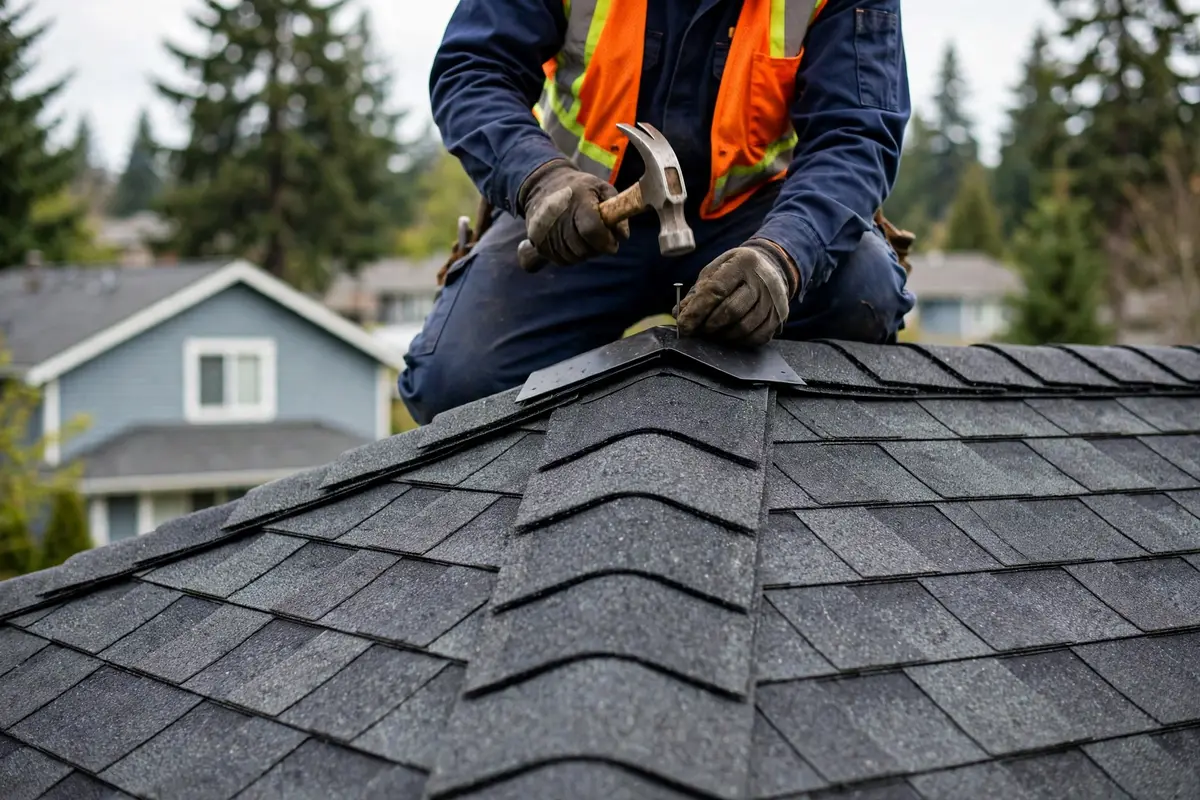
Ridge cap repair in Bellevue, WA usually starts at the peak, because the ridge takes the most wind and weather on the whole roof. The caps are the special shingles that cover the peak, bent over the ridge and sealed in place. When they crack, lift or go missing, water gets straight into the top of the roof.
Missing ridge cap shingles
Missing ridge caps are the first thing to check after a windstorm, because the peak gets the highest wind exposure on the roof. A gap at the ridge lets water straight into the peak, even if the field shingles below look fine. Missing caps are replaced with matching cap shingles, nailed on both sides of the ridge and sealed.
Cracked ridge caps
Ridge caps bend over the peak, so they crack from age and from the repeated flexing of heat and cold. A cracked cap can look intact from the ground while letting water through the crack. Cracked caps are replaced rather than sealed, because sealant on a bent, brittle cap does not hold.
Wind damage
Wind lifts ridge caps from the peak, breaks the seal strip underneath and can peel a run of caps in one storm. After a windstorm, the ridge is the first place to check from the ground — look for gaps along the peak or caps sitting crooked. Caps that have lifted but not cracked can sometimes be resealed; creased or torn caps need replacing.
Ridge cap seal failure
Each ridge cap is held by a seal strip that bonds it to the cap below it. When the seal fails, the cap lifts in the wind and rattles, and water can blow in underneath. Resealing works only if the cap is still flexible and undamaged — a brittle cap that has lost its seal needs to be replaced, not glued down.
Replacement methods
To replace ridge caps, we remove the damaged caps and check the ridge vent and the seal beneath them before installing new ones. New cap shingles are matched to the existing roof, nailed on both sides of the ridge and sealed so each cap overlaps the next and sheds water down the slope. The repair is photographed before and after, so you can see the ridge is sealed along its full length.
What to Expect During Roof Flashing and Ridge Cap Repair
A single flashing repair is usually completed in a day. Roof ridge repair Bellevue homes need can take longer than a single flashing fix, depending on the length of the ridge and access. You receive photos of the failed flashing and the repair.
Why Homeowners Choose Us
Older homes in Lake Hills, Eastgate and Newport Hills often have original flashing that has outlived its sealant, while hillside homes in Somerset and West Bellevue put the most wind load on ridge caps — ridge cap shingle repair Bellevue homeowners there need is usually for lifted or missing caps. Both are routine repairs for us in Bellevue.
Cost: Replacing a few damaged asphalt shingles usually costs about $100 to $700 throughout Bellevue, WA. Our small repairs usually run $300-800. You get an exact price in writing after the inspection.
Related Shingle Repair Services
- Roof Leak Repair in Bellevue, WA
- Roof Valley Repair in Bellevue, WA
- Roof Vent Repair in Bellevue, WA
- Storm Damage Roof Repair in Bellevue, WA
Roof Flashing and Ridge Cap Repair FAQs
What is step flashing and where is it used?
Step flashing is a set of small L-shaped metal pieces fitted where a roof meets a wall or chimney, with each piece woven between the shingle courses so water is directed down and out. It is used at chimneys, dormers, skylights and any wall that rises from the roof. If step flashing rusts, gaps or comes loose, water gets behind it and into the house.
How do I know if my chimney flashing has failed?
Look for water stains on the ceiling or wall near the chimney, damp brickwork, rust streaks, or flashing that has pulled away from the chimney or the roof. In the attic, damp insulation around the chimney base is a clear sign. Chimney flashing is one of the most common leak sources we find, and an inspection can confirm whether it is the flashing or the shingles around it.
What is a ridge cap and why does it need repair?
A ridge cap is the row of special shingles that covers the peak of the roof, where the two slopes meet. The ridge takes the most wind and weather, so cap shingles are often the first to crack, lift or go missing. A damaged ridge cap lets water straight into the peak of the roof, so we treat it as urgent and replace the damaged caps.
Can flashing be repaired without replacing the shingles around it?
Sometimes. A small gap can be resealed, but a proper flashing repair usually means lifting the shingles beside the flashing so the new metal sits under them correctly. If we just seal over the top, the repair rarely lasts. We lift and refit the surrounding shingles as part of the job, so the flashing and the shingles work together to shed water.
Why does flashing fail before the shingles do?
Flashing is thin metal that expands and contracts with temperature, while the shingles around it move differently, so the seal between them works loose over time. Sealant also ages and dries out. Because flashing sits at every joint and transition — chimney, valley, skylight, wall — it takes more movement and more water than the flat shingle field, so it is usually the first part to fail.
What is the difference between flashing and a ridge vent?
Flashing is metal that seals a joint so water cannot get in, while a ridge vent is a vented cap along the peak that lets hot, moist air out of the attic. Both sit at the ridge, but they do different jobs: flashing keeps water out, and the vent lets air out. A ridge vent still needs flashing around it, and a damaged ridge vent can let rain in just like failed flashing.
Does a skylight need flashing?
Yes. Every skylight needs step flashing around its sides and counter flashing at the top, fitted under the shingles so water runs around the skylight and off the roof. Most skylight leaks are not the skylight itself — they are failed flashing or worn sealant around it. When we repair a skylight leak, we usually replace the flashing and reseal the joint rather than replacing the skylight.
Can you replace ridge cap shingles on their own?
Yes. Ridge cap shingles are separate pieces made for the peak, so we can replace only the damaged caps without touching the rest of the roof. We lift the old caps, check the ridge underneath, fit new caps in the matching profile and colour, and seal them. If the ridge underneath is soft or the caps keep failing, we will tell you the ridge needs more than a cap replacement.
What causes flashing to rust or corrode?
Age, standing water, and contact between different metals are the main causes. In Bellevue, constant moisture speeds up corrosion, and debris that holds water against the metal makes it worse. Once flashing rusts through or develops holes, it cannot be sealed — it has to be replaced. We check flashing for rust and holes on every inspection, because a small rust spot becomes a leak.
How long does a flashing repair last?
A properly fitted flashing repair should last as long as the shingles around it, because the new metal is fitted under the shingles the same way as the original. How long it lasts depends on the metal, the exposure, and whether the sealant is maintained. A repair that is only sealed over the top, without refitting the metal, rarely lasts — that is why we lift the surrounding shingles and fit the flashing properly.