
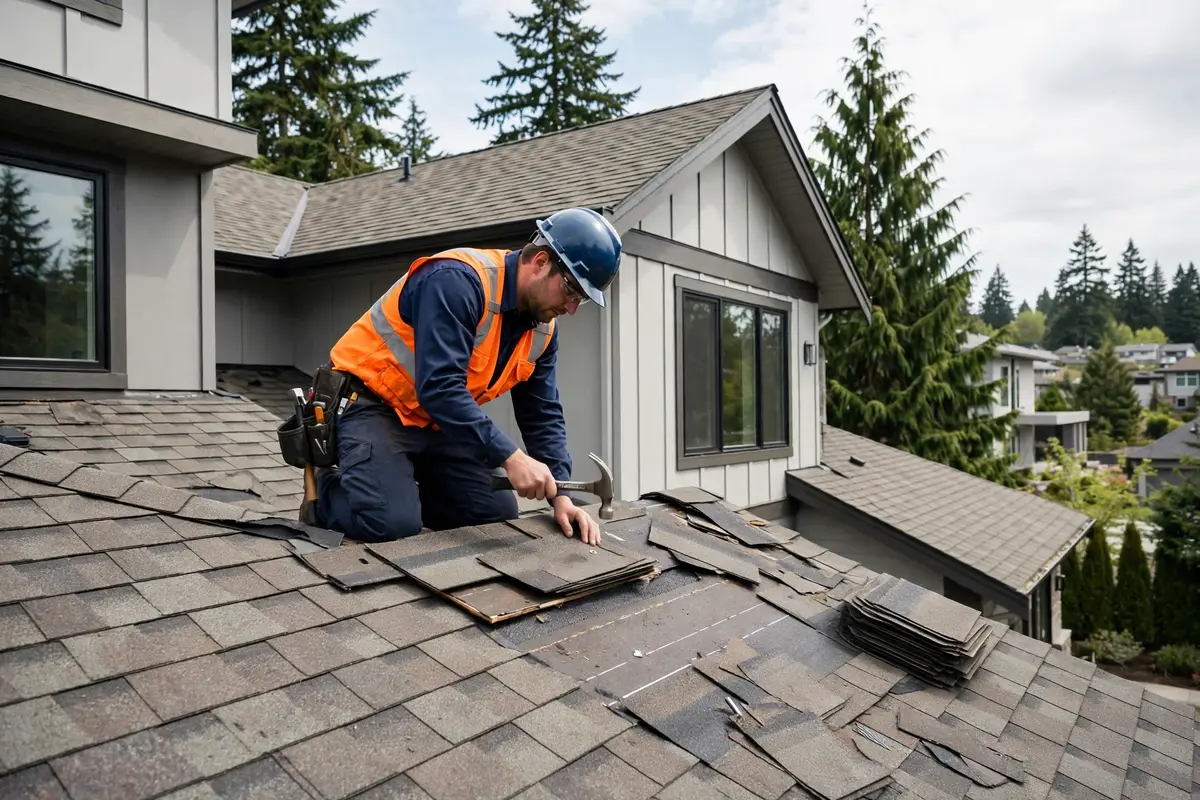
Asphalt Shingle Repair in Bellevue, WA
Asphalt shingle repair in Bellevue, WA — three-tab and architectural shingles repaired, matched and replaced. Serving Crossroads and Northeast Bellevue (98007). Call (425) 738-3670.
Asphalt shingles are the standard roofing on Bellevue houses, and almost every shingle repair we do is an asphalt shingle repair. This page covers the material itself: three-tab and architectural shingles, how they fail in Bellevue’s climate, and how we repair and match them. Composition shingle repair Bellevue homeowners ask about is the same service — composition is the other name for asphalt shingles. If you are not sure what type of shingle is on your roof, we identify it during inspection.
The Problem: Cracked, Curling and Worn Asphalt Shingles
Asphalt shingles fail through ageing, thermal movement, moisture and wind. Three-tab shingles are single-layer and lighter; architectural shingles are laminated, thicker and heavier. Both can crack, curl, lose granules and lift in wind, and when the edges stay curled we replace curled asphalt roof shingles rather than trying to flatten them. In Bellevue, moss and algae add a further cause: moss holds moisture against the shingle and lifts its edges, while black streaks are usually Gloeocapsa magma algae feeding on the limestone filler in the shingle.
Signs You Need Asphalt Shingle Repair
- Curling, cupping or clawed shingle edges
- Cracked or split shingles
- Bald patches where granules have gone
- A roof that looks wavy or uneven
- Shingles that are brittle to the touch
Asphalt shingles damaged? Call (425) 738-3670.
Our Inspection and Repair Approach
We identify the shingle type and profile, check how much of the roof is affected and how old it is, and then advise repair or replacement honestly. For asphalt roof repair Bellevue homeowners need, a localised repair uses matching shingles; to repair aging composition roof sections, we replace the worn shingles with matching ones, and where wear is widespread across most slopes, replacement is usually better value. Where granules have gone, we fix granule loss on shingles by replacing the bare shingles, not by coating them. We explain both options with costs in writing.
Asphalt Shingle Repair Methods
Repairs replace damaged shingles with the same profile — three-tab with three-tab, architectural with architectural — and the nearest colour blend. Architectural shingle repair Bellevue homeowners ask for follows the same rule. To match replacement asphalt shingles to your roof, we compare the new shingles against the existing ones before nailing them in. Where a shingle has cracked, we repair cracked asphalt shingles by lifting the row above, removing the damaged shingle and nailing a matching one in its place. Where moss is the cause, we treat it with a low-pressure soft wash and replace the shingles it has already lifted. We never pressure wash an asphalt roof.
Cracked or curled shingles? Call (425) 738-3670.
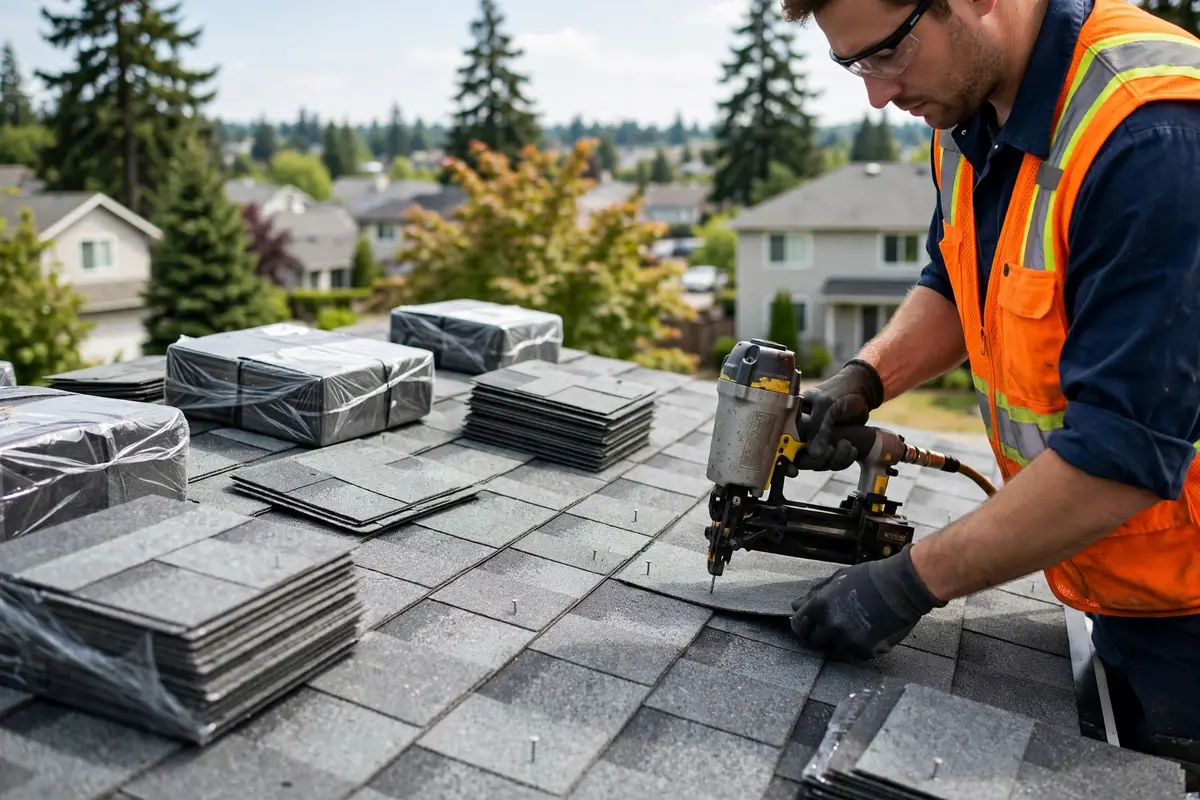
Asphalt Shingles: The Material Behind the Repair
Most repair decisions are made by the shingle itself — its type, its layers, its brand and how it was nailed down. This section explains the material, so you can see why a repair is done a certain way. The repair steps themselves are covered on our shingle roof repair page.
Three-tab vs architectural shingles
Three-tab shingles are a single flat layer cut into three tabs, giving a uniform, flat pattern on the roof. They are lighter and thinner, and they are the shingle most often found on older Bellevue homes built from the 1960s to the 1990s. Architectural shingles — also called laminated or dimensional shingles — are made of two or more layers bonded together, so they are thicker and heavier, with a dimensional look and shadow lines. They are the more common choice on newer homes, and they resist wind lift better because of their weight and the larger sealed area. Both types are asphalt shingles, and the repair rule is the same for both: a damaged shingle is replaced with one of the same profile — three-tab with three-tab, architectural with architectural — because the thickness and pattern do not match across types.
| Feature | Three-tab shingles | Architectural shingles |
|---|---|---|
| Layers | Single flat layer | Two or more layers laminated together |
| Look | Flat, uniform tab pattern | Thicker and dimensional, with shadow lines |
| Weight | Lighter | Heavier |
| Common on | Older Bellevue homes, 1960s to 1990s | Newer homes |
| Repair matching | Replace with three-tab only | Replace with architectural only |
How an asphalt shingle is built
An asphalt shingle is also called a composition shingle, because it is made of several materials pressed together. Composition roofing is the same material under its other name. Each shingle has four parts, and each part has a job to do.
| Part | What it is | What it does |
|---|---|---|
| Fiberglass base mat | A woven fiberglass sheet at the core of the shingle | Gives the shingle its shape and tear strength |
| Asphalt coating | Asphalt saturating and coating the mat | Makes the shingle waterproof |
| Asphalt roofing granules | Ceramic-coated mineral granules pressed into the asphalt surface | Give the shingle its colour, block ultraviolet light and add fire resistance |
| Seal strip | A heat-activated adhesive strip on the shingle face | Bonds each course of shingles to the one below it |
When any one of these parts fails, the shingle fails with it. A torn mat lets the shingle split, worn asphalt lets water through, lost granules leave the asphalt exposed to the sun, and a seal strip that never bonds leaves the shingle free to lift in wind. That is why an inspection looks at the shingle itself, not just the leak it caused.
Shingle manufacturers
Four manufacturers make most of the asphalt shingles fitted on Bellevue roofs: GAF, Owens Corning, CertainTeed and Malarkey. Each makes both three-tab and architectural lines, and each has its own profiles and colour blends — which is why matching a repair starts with identifying the brand. Bellevue Shingle Masters holds contractor certifications from all four: GAF Master Elite Contractor, Owens Corning Preferred / Platinum Preferred Contractor, CertainTeed ShingleMaster / Select ShingleMaster and Malarkey Emerald Pro. Other manufacturers make asphalt shingles too, but these four are the ones whose products we are certified to install and repair, and they are the products we match against when we source replacement shingles.
How to identify a shingle brand
The fastest way to identify a shingle is the paperwork from the original installation — the warranty documents or any leftover packaging usually name the manufacturer and the product line. Without paperwork, the next place to look is the underside of a shingle, where the manufacturer name and product line are often printed on the backing. The profile and colour blend can also narrow it down, because each manufacturer's architectural line has a distinctive pattern and granule mix. When no markings survive, the brand is identified during inspection: the shingle type and profile are matched against the products we know, and the closest match is sourced from there. Identification is not always possible from the ground, which is one reason a repair starts with an inspection rather than a guess.
How to match discontinued shingles
Shingle lines are discontinued regularly, colours change between production runs, and the shingles already on a roof fade in the sun — so an exact match is not always possible. When the original line is gone, the repair is matched in one of four ways. First, the supplier is checked for remaining stock of the same line and colour. Second, the closest current colour and profile from the same manufacturer is used. Third, a shingle is taken from a less visible slope, such as the rear of the house, and used on the visible repair, while the donor spot is filled with the new match. Fourth, a whole slope is re-shingled, so the repair blends across one unbroken surface instead of standing out as a patch. Which option fits depends on how much of the roof is affected and how visible the repair will be, and the options and their costs are discussed in writing before work starts.
Granule loss and shingle deterioration
Asphalt roofing granules are the ceramic-coated mineral coating pressed into the surface of every shingle. They give the shingle its colour, they block ultraviolet light from reaching the asphalt underneath, and they add fire resistance. Granules come off with age, weather, hail impact, foot traffic on the roof, moss growth lifting them, and heat building up under a poorly ventilated roof. The signs are bald patches where the shingle surface looks smooth and dark, and granules collecting in the gutters and downspouts. Once the granules are gone, the exposed asphalt degrades faster in the sun, the shingle turns brittle, and it starts to curl and crack. Deterioration follows that order — granule loss, then brittleness, then cracking and curling, then leaks — which is why a roof with widespread bald patches is usually assessed for replacement rather than patched shingle by shingle. Where the loss is local, the bare shingles are replaced; no coating restores granules that are already gone.
Shingle seal strips and nail patterns
The seal strip is the heat-activated adhesive on each shingle that bonds one course to the one below it. It needs warmth from the sun to bond, which is why a repair done in cold weather is hand-sealed with roofing cement instead of relying on the sun. When a seal strip never bonds, or breaks down with age, the shingle lifts in wind, creases along the fold and can blow off altogether. The nails matter just as much. Each shingle is fastened with nails set in the manufacturer's marked nailing zone, driven flush with the shingle surface, in the number the manufacturer specifies — most specify four nails per shingle, with six in high-wind installations. Nails placed too high miss the shingle below and let it slide; nails placed too low sit exposed to the weather; nails driven too deep cut through the mat; nails left proud hold the shingle up off the course below so it can lift. When the cause of a failure is not obvious from the surface, the inspection checks the nail placement as well as the shingle.
Shingle warranties and repair limitations
What a shingle warranty covers depends on the product and its terms, so there is no single answer that fits every roof. A manufacturer warranty generally covers defects in the shingle itself; it does not automatically cover damage caused by weather, installation problems or lack of maintenance — but the exact scope, and what is excluded, depends on the product and its terms. A repair can also affect warranty coverage: using shingles that do not match the original product, or a repair method that does not follow the manufacturer's instructions, may affect it. Homeowners should check their warranty terms before a repair is done. We do not determine warranty outcomes — that is between the homeowner and the manufacturer — but we explain what the repair involves, use matching materials where they are available, and follow manufacturer methods so the repair does not create a new problem.
What to Expect During Asphalt Shingle Repair
A localised asphalt shingle repair is usually completed in a day. When asphalt roof shingle replacement is needed across a whole slope, matching is discussed before work starts, including when a perfect match is not possible because the line is discontinued or the existing shingles have faded.
Why Homeowners Choose Us
Residential asphalt shingle repair covers most Bellevue homes built from the 1960s to the 2010s — mid-century homes in Lake Hills and Eastgate, hillside homes in Somerset, and planned communities in Cougar Mountain and Lakemont. We stock the common profiles used on those roofs.
Cost: Replacing a few damaged asphalt shingles usually costs about $100 to $700 throughout Bellevue, WA. Our small repairs usually run $300-800. You get an exact price in writing after the inspection.
Related Shingle Repair Services
- Shingle Roof Repair in Bellevue, WA
- Missing Shingle Repair in Bellevue, WA
- Roof Inspection in Bellevue, WA
- Roof Flashing & Ridge Cap Repair in Bellevue, WA
Asphalt Shingle Repair FAQs
What is the difference between 3-tab and architectural shingles?
3-tab shingles are a single flat layer with a uniform tab pattern, while architectural shingles are laminated in two or more layers, giving a thicker, dimensional look. Architectural shingles usually cost more and resist wind better, and they are the more common choice on newer Bellevue homes. We repair both types and match the profile of the shingles already on your roof.
Do architectural shingles last longer than 3-tab shingles in Bellevue?
Yes, usually. Architectural shingles are thicker and heavier, so they resist wind lift and granule loss better than 3-tab shingles, and they often outlast them by several years. In Bellevue, asphalt shingle roofs typically last 15–20 years, with persistent moisture and shade from tall conifers wearing them faster. An inspection shows how much life your particular roof has left.
What causes asphalt shingles to blister?
Blisters are small raised bubbles on the shingle surface, usually caused by trapped moisture or air under the shingle, or by heat building up in a poorly ventilated attic. The blister itself is not a leak, but when it breaks open it leaves a bare spot where granules are gone and water can get in. We check for blistering on every inspection and replace the affected shingles.
Can hail damage asphalt shingles without breaking them?
Yes. Hail often bruises asphalt shingles rather than breaking them — the impact knocks granules off and dents the mat underneath, but the shingle may still look intact from the ground. That hidden damage shortens the shingle's life and can lead to leaks later. After a hailstorm, an inspection finds the bruised shingles and tells you whether a repair is needed.
Are dark streaks on asphalt shingles a problem?
Dark streaks are usually algae, not damage — a blue-green algae that grows on shaded, damp shingles and leaves black streaks running down the roof. The streaks are mostly cosmetic, but the algae holds moisture against the shingle and speeds up wear. A low-pressure soft wash removes the algae; never pressure wash a shingle roof, because it strips granules and shortens the roof's life.
Can you repair asphalt shingles in cold or wet weather?
Yes, with care. Shingle seal strips need warmth to bond, so in cold weather we hand-seal the replacement shingles with roofing cement instead of relying on the sun to seal them. In wet weather we wait for a dry window when we can, because a wet deck makes the repair harder to do well. Call (425) 738-3670 and we will give you an honest response time for your roof.
Do architectural shingles seal differently from 3-tab shingles?
Both types use a heat-activated seal strip that bonds one shingle course to the next, but architectural shingles are thicker and heavier, so the seal has more surface to grip and the shingles sit flatter. Three-tab shingles are thinner and lighter, so they rely more on the seal and the nails. On either type, a seal that has not bonded leaves the shingle free to lift in wind.
Do asphalt shingles need ventilation underneath?
Yes. Air moving through the attic carries away heat and moisture that would otherwise bake the shingles from below and shorten their life. Poor ventilation can also cause curling and moss growth on the shingle surface. When we inspect a roof, we look at the attic ventilation as well as the shingles, because fixing ventilation is often part of a lasting repair.
Do discontinued shingles affect the price of a repair?
A discontinued colour can add to the price, because the roofer may need to source a close match from a supplier, use a different batch, or replace a larger area so the patch blends in. In some cases the only good match is to re-shingle a whole slope. The quote will show the price before work starts, so you can decide whether to match or to re-shingle.
Can moss be removed from asphalt shingles without damaging them?
Yes, with a low-pressure soft wash that kills moss and algae at the root and lets the rain rinse it away. Never pressure wash a shingle roof — the high-pressure water strips granules and shortens the roof's life. Moss holds water against the shingles and lifts their edges, so we check for moss on every inspection and tell you whether a soft wash is needed.