
Roof Flashing Problems and Leaks
flashing is the metal that seals the places where a roof changes direction or meets something else — a chimney, a valley, a skylight, a wall. When flashing fails, water gets in even though the shingles look fine. This guide explains the com
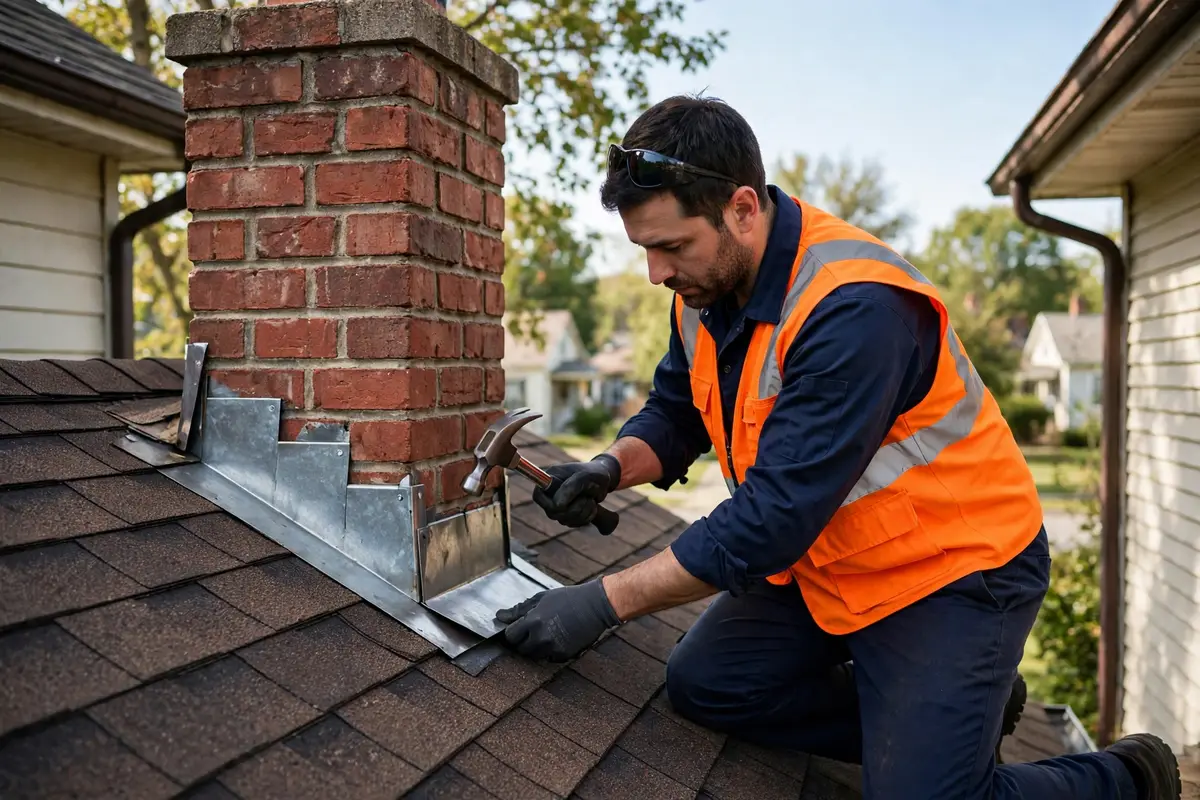
Flashing is the metal that seals the places where a roof changes direction or meets something else — a chimney, a valley, a skylight, a wall. When flashing fails, water intrusion starts even though the shingles look fine. This guide explains the common flashing problems and how they are fixed.
Chimney Flashing Problems and Roof Leaks
Chimney flashing has two parts: step flashing up the side of the chimney, and counter flashing set into the masonry. At the bottom of the chimney, apron flashing — a single piece of metal that runs across the base — keeps water from running down the chimney and under the shingles. Sealant failure is the usual cause of a leak here: when sealant ages or the metal lifts, water runs down the chimney and into the roof. A flashing leak often shows up away from the failure: the stain appears on the wall below the chimney, not at the flashing itself. Inside, an attic stain on the decking or a rafter is often the first sign, before the stain reaches a ceiling or wall.
Valley Flashing Problems and Roof Leaks
Valleys carry the most water on a roof. Valley metal can corrode, lift, or be damaged by debris, and the shingles in the valley wear faster than elsewhere. A valley leak is often large and persistent.
Flashing leaking? Call (425) 738-3670.
Skylight and Vent Flashing Problems
Skylights and vents are penetrations, and every penetration is a potential leak. Skylight flashing ages, and pipe boots crack with age and sun. A pipe boot is a rubber boot: a rubber collar around a plumbing vent. A pipe boot leak starts when that collar cracks and water runs down the vent pipe and into the roof. Both are routine repairs.
How Roof Flashing Is Fixed
Failed flashing is replaced, not sealed over. We lift the surrounding shingles, replace the metal and the underlayment beneath where needed, and re-lay the shingles. If the leak has been there a while, decking rot may mean a section of decking has to be replaced too. Sealant is used where it is the correct fix, not as a substitute for new metal. Ridge caps are part of the same job: the ridge vent and the cap shingles over it are checked, and the ridge seal — the seal under the cap shingles at the peak — is what keeps wind-driven rain out of the ridge. Hip cap shingles, the caps along a hip where two slopes meet at an angle, are checked the same way. Wind uplift at ridge level is what lifts cap shingles first, because the peak catches the wind from both sides.
Need professional help? If this describes your roof, our roof flashing & ridge cap repair in Bellevue, WA service covers it. Call (425) 738-3670 or request an estimate.
Key takeaways
- Most leaks start at a joint — chimney, valley, skylight or vent.
- Step flashing, valley flashing and pipe boots all fail with age.
- Flashing is fixed by replacement or resealing, not by paint.
Leak at the chimney? Call (425) 738-3670.
Frequently Asked Questions
Why is step flashing used at walls instead of one long piece?
Step flashing is a set of small, overlapping metal pieces fitted where a roof meets a wall, such as at a chimney or a dormer. Each piece overlaps the shingle below it and sits under the shingle above it, so water runs down the steps and off the roof. One long piece cannot follow the slope and would leave gaps, so the stepped pattern is what keeps the joint watertight.
What does failed chimney flashing look like from the ground?
From the ground, look for rust stains running down the chimney, gaps where the metal meets the brick, or flashing that has lifted away from the wall. Inside, a stain on the ceiling near the chimney is a common sign. You cannot see the sealant or the step flashing from the ground, so a roofer needs to get on the roof to confirm the failure and price the repair.
Why do pipe boots leak more often than other flashing?
A pipe boot is a rubber collar that seals around a vent pipe where it passes through the roof, and the rubber wears out faster than the metal flashing around it. Sun, heat and cold make the rubber crack and shrink, and once it splits, water runs down the pipe into the attic. A cracked boot is a small, common repair — the boot is replaced and the shingles around it are resealed.
How do you replace flashing under existing shingles?
The roofer lifts the shingles above the flashing, removes the old piece, and slides the new flashing under the shingles so it overlaps correctly. The shingles are then laid back down and resealed, and any cracked or brittle shingles are replaced. It is a careful job, because the shingles must be lifted without tearing them, but it does not mean re-shingling the whole roof.
Why does valley flashing leak?
A valley carries more water than any other part of the roof, so any weakness there shows quickly. Valley flashing leaks when it rusts, when shingles in the valley crack or lift, or when leaves and debris dam water in the valley and push it under the shingles. A valley leak often appears as a stain some distance from the valley, because water travels along the rafters.
What is the difference between step flashing and continuous flashing?
Step flashing uses separate L-shaped pieces layered with each shingle course, so each piece moves slightly with the roof. Continuous flashing is one long piece of metal, usually along a wall, and it can buckle or pull away as the roof and wall move differently. Step flashing is the better detail for chimneys and walls, and continuous flashing is more likely to leak as it ages.
How long does roof flashing last?
Metal flashing can last 20 to 30 years, but sealant and rubber parts fail sooner — pipe boots often crack after 8 to 15 years, and the sealant at a chimney can dry out in 10 years or less. Flashing also fails early if it was installed badly or the roof moves. An inspection checks flashing separately from shingles, because the two wear out at different rates.
Can I reseal flashing myself?
A bead of roofing sealant can slow a small flashing leak, but it is not a lasting repair. Sealant dries, cracks, and peels, especially on a chimney or valley that moves with heat and cold. The lasting fix is to replace the damaged flashing or the failed seal, with the shingles lifted and relaid properly. Resealing from the ground is a stopgap, not a repair.
Can rusted flashing be repaired, or does it need replacing?
Light surface rust can sometimes be cleaned and sealed, but rust that has eaten through the metal cannot be repaired — the flashing has lost its strength and will leak. The roofer will replace the rusted piece, reseal the joint, and check the shingles around it for water damage. Galvanised and aluminium flashing resist rust better than plain steel, which is why they are used on most Bellevue roofs.
Should flashing be replaced when shingles are replaced?
Yes, usually. New shingles on old flashing leaves the weakest part of the roof in place, and the old flashing will likely leak before the new shingles wear out. Replacing flashing with the shingles costs less than coming back to lift new shingles later. If the flashing is still sound, a roofer may reuse it, but that is the exception, not the rule.